
Financially Speaking
By: Shabri Moore CFP®, AIF®
Being a grandparent has been one of the greatest joys of my life. Playing with Donovan and observing life from his perspective has been so much fun! It’s made me think about the many things that a grandparent has the opportunity to share with grandchildren.
Grandparents leave behind more than fond memories and family traditions. We also have the opportunity to pass along values that shape how future generations think. Through conversations, shared experiences, and everyday actions, we can help grandchildren build financial habits that last a lifetime. Here are a few values worth sharing:
We take care of what we own.
If a grandchild’s bike starts squeaking or the tires need air, spend an afternoon cleaning it, lubricating the chain, and making simple repairs together instead of immediately replacing it. This teaches that taking care of your belongings can extend their life, save money, and build an appreciation for what you already own.
We don’t chase every trend.
If everyone seems to have the latest gadget or fashion, talk about why it’s okay to wait or skip it altogether. What’s a trend that was popular when you were young, that in hindsight might seem silly and relatable? Choosing not to follow every trend builds confidence and helps children avoid spending simply to fit in.
We know the difference between price and value.
Sometimes spending a little more upfront makes sense if something will last for years. Comparing two backpacks or pairs of shoes can help grandchildren understand that the lowest price isn’t always the best value.
We leave things better than we found them.
Whether it’s returning a borrowed tool in better condition or cleaning up after a family picnic, connect stewardship with financial responsibility. Taking care of shared resources is another way of respecting value.
We invest for the long term.
For older grandchildren, consider co-managing a small custodial investment account. Review it together every few months and discuss why investments rise and fall. It’s an opportunity to teach patience, diversification, and the value of staying focused on long-term goals.
We give because we care.
Invite your grandchild to choose a cause that’s meaningful to them and donate a small portion of birthday money or holiday gifts. They’ll learn that generosity isn’t measured by the size of the gift but by the desire to help others.
We don’t waste what we have.
Before making a trip to the grocery store, challenge your grandchild to help create a meal from ingredients already in the pantry. It’s a simple way to show that creativity and resourcefulness can save money and reduce waste.
These lessons are often most effective when they come through shared experiences rather than speeches. Fixing a bike together, comparing products at the store, or talking through an investment decision can spark meaningful conversations without sounding like “back in my day” or “kids these days.” By leading with curiosity instead of criticism, grandparents can share timeless financial values in ways that resonate with the next generation.
In this quarter’s newsletter you’ll find an article by Sean, “We Can Advise You on That!”, and article by Erik, “Higher for Longer, Again?” We’ve also included an article exploring when it may make sense to give your children their inheritance, along with our Third Quarter Economic Update.
Be sure to scroll all the way to the end for information about our upcoming Client Appreciation Event and our fall educational event, “The Generational Divide.” We hope you enjoy this quarters edition!
We Can Advise You on That!
By: Sean Moore CFP®, AIF®
Most Moore Wealth clients typically come to us with questions about anything and everything. We’re honored to be a trusted sounding board for you! Sometimes though, clients tell us “I don’t think that’s your job,” or “I didn’t think you did that for me.” My goal with this article is to share a few interesting – if uncommon – ways we have advised clients in the past, with the hope that it will encourage you to ask for our support on anything and everything. Chances are: we can advise you on that!
Is this legitimate?
Fraud and scams are everywhere, and it can be really taxing to determine whether something is a legitimate communication, coming from a legitimate source. This isn’t intended to be a “here’s how to spot a scam” list. Rather, it’s a reminder that if you aren’t sure, get in touch so we can help you figure it out.
Some time ago, we had a client reach out about an email they believed to be legitimate demanding payment for a gun they were told they had purchased in another state. This client has never held or fired a gun, let alone contemplated purchasing one, so they were understandably alarmed! Knowing that the client is not a firearms enthusiast, along with a review of the message they received, was sufficient for us to encourage them to send the message to their spam folder.
Is business class really worth it?
Many of you know that the Moore Wealth team are all travel enthusiasts. Did you know that we’re also travel strategists?
In addition to being our Founder and Principal, Shabri is also our Chief of Points (trademark pending) – she’s a master of earning and using credit card points to snag amazing deals on travel. Shabri likes to travel in style, but she hasn’t paid cash for an international flight in at least the last ten years. Consider upgrading your travel experience on your next adventure – ask us how!
I’m only going to wear it once!
As we move toward the holiday season, we’re approaching a time when formalwear potentially gets more use. Even during the season when being budget conscious can take a back seat, clients often have a hard time justifying the cost associated with purchasing an outfit that will only be worn once.
A few years ago, a client had a summer of weddings, most of them for family or family friends. She was going to see a very similar guest list at every event, but couldn’t conceive of spending on a new outfit for each one. After all, she was only going to wear each outfit once!
A number of clients, friends, and family members had previously had great experiences with Rent the Runway, so we encouraged this client to take a look. She was able to be well dressed at a reasonable cost during her busy wedding season, and ended up enjoying the experience so much that she hasn’t purchased a new formal outfit since.
I don’t know what I want to be when I grow up…
Major life changes are our bread and butter – they nearly always have a set of financial considerations connected to them. But what about when financial considerations aren’t front and center in your decision-making process?
A few years ago, a client was sharing life updates, to include updates on her children and grandchildren. An update on one of her grandsons turned into a life planning conversation for the grandson. He played baseball in college, and had the opportunity to play for a AAA team following graduation.
Given my own non-linear career progression, I encouraged the grandson to pursue playing AAA baseball rather than immediately beginning a career in accounting. What a great, and unique opportunity – it would be a shame to see him decline it in favor of “being a grown-up.” It certainly didn’t hurt that he was pursuing the additional credit hours he needed to sit for the CPA exam while he was off the field!
Is this covered by advisor client privilege?
We don’t operate in the same way as a law firm or attorney – if you’ve been charged with a crime, you should not contact us first!
Kidding aside, we keep client information strictly confidential, even in situations you might not expect. Recently, we worked with a client through a major career and life change. The change this client was contemplating was huge for them and their family, but also had implications for their professional and personal communities. Through their contemplation and planning process, we were a trusted resource for them, both for how it would impact their family, and for how they could manage information and change for people outside of their family unit.
We can advise you on just about anything!
I hope that you’ve enjoyed this sampler of non-traditional advising situations that we have helped clients with in the past. We are always here to help with situations including: sale or purchase of a business, retirement, death of a loved one, divorce, college planning, career changes, major purchases, budgeting, and estate planning, to list just a few.
Please do not hesitate to call, email, or schedule an appointment to discuss anything you could use guidance on – we’re here for you, and we’re happy to help.
Higher for Longer, Again?
What Today’s Interest-Rate Environment Means for Your Financial Plan
By: Erik Moore CPWA®, AIF®
For much of the past several years, investors have been waiting for interest rates to “get back to normal.” The problem, however, is that normal is difficult to define. For nearly 15 years following the Global Financial Crisis, investors became accustomed to exceptionally low interest rates. Mortgages could be obtained at historically attractive rates, businesses had access to inexpensive capital, bond yields were relatively low, and investors were frequently encouraged to take more risk in search of better returns.
Now, the environment has changed. Inflation, government borrowing, economic growth, employment, and Federal Reserve policy have all contributed to an interest-rate environment that looks very different from the one many investors grew accustomed to during the 2010s. So, the natural question is: when will rates come back down? At Moore Wealth, we think there may be a better question: what if they don’t?
Rather than building a financial plan around a prediction for where interest rates will be six or twelve months from now, it may be more useful to understand what today’s higher-rate environment means for the decisions we are making now.
Higher Rates Aren’t Necessarily Bad for Investors
Higher interest rates are usually discussed as a negative, and there are good reasons for that. Higher borrowing costs can slow economic activity, increase mortgage payments, make business investment more expensive, and put pressure on the valuation of stocks and other assets.
There is another side of the equation though. For the first time in many years, investors can earn meaningful income from relatively conservative investments. Cash, money-market funds, Treasury securities, CDs and high-quality bonds can provide levels of income that were largely unavailable during the years following the Financial Crisis. This changes the investment conversation.
An investor seeking a reasonable return no longer necessarily needs to move as far out on the risk spectrum to find it. For retirees in particular, this can create opportunities to build portfolios where a greater portion of spending needs may be supported through interest and income rather than relying exclusively on appreciation.
This doesn’t mean investors should abandon stocks. It means the tradeoff between risk and potential return has changed, and portfolios should recognize that.
Bonds Deserve Another Look
One of the more difficult periods for traditional diversified portfolios occurred in 2022 when stocks and bonds declined simultaneously. Understandably, that caused some investors to question the role bonds should play in a portfolio. But there is an important distinction between looking backward at what happened to bond prices and looking forward at the income those bonds may now generate.
As interest rates increase, existing bonds with lower yields declined in value. New bonds, however, begin offering higher yields. For long-term investors, that means the starting point for fixed income today is very different from an environment in which bonds were yielding 1% or 2%.
Depending on the investor, bonds can once again serve several purposes: generating income, reducing overall portfolio volatility, providing liquidity, and creating a potential source of funds during periods when selling stocks may be unattractive. The appropriate allocation will vary, but fixed income should not necessarily be viewed through the lens of what happened during the last rate cycle.
Cash Has Become an Asset Again
For years, holding significant cash came with a substantial opportunity cost. With interest rates near zero, cash provided liquidity but very little return. Investors often had to choose between accepting almost no income or putting that money into investments carrying greater risk.
Today, that decision is more nuanced. Cash can serve several purposes within a financial plan. It can provide a reserve for upcoming spending. It can reduce the need to sell investments during periods of market volatility. It can provide capital for opportunities that arise during market declines. And, in the current environment, it may generate meaningful interest while waiting.
But there is an important distinction between strategically holding cash and simply sitting on the sidelines. Cash can be useful when it has a purpose, but holding excessive cash indefinitely because we are waiting for the “right” time to invest can create an entirely different risk: missing years of potential growth while waiting for an event that may never occur.
Higher Rates Affect More Than Your Investment Portfolio
Interest rates aren’t simply an investment issue, they affect decisions throughout a financial plan. Consider a homeowner with a mortgage originated several years ago at a very low fixed rate. Paying that mortgage down aggressively may not provide the same economic benefit as it would if the loan carried a significantly higher interest rate. At the same time, someone considering a new home purchase today faces a very different calculation around affordability, down payments and financing.
Business owners face similar questions. Higher borrowing costs can affect expansion plans, acquisitions, equipment purchases and business valuations. A project that made sense when capital was inexpensive may look different when financing costs are several percentage points higher.
Even estate and charitable planning can be influenced by interest rates, as certain planning strategies become more or less attractive depending on the prevailing rate environment. This is why we view interest rates as a financial-planning issue, not simply something for bond investors to watch.
Should We Wait for Rates to Fall?
Predicting interest rates is difficult. Even professional economists and market participants routinely disagree about where rates will be a year from now.
A financial plan that requires a particular interest-rate forecast to be correct isn’t much of a plan. Instead, we prefer to ask the following: what opportunities are available at today’s rates, what risks would we face if rates remain elevated, what happens if rates decline, and does the financial plan work reasonably well under each scenario?
This approach may not produce an exciting prediction for where the Federal Reserve will move next, but it creates something far more useful: flexibility.
Planning for the Environment We Have
Interest rates will eventually change, they always do. The challenge is that we don’t know exactly when, how quickly, or in which direction. So rather than waiting for the investment environment to return to what we became accustomed to, investors should consider whether today’s environment presents opportunities of its own.
Higher rates create challenges for borrowers, businesses and certain investments. They can also create better income opportunities, more attractive fixed-income options, and a greater return on liquidity.
The goal is to build a financial plan that doesn’t depend on getting an interest rate prediction right.
At Moore Wealth, we believe good financial planning should account for a range of possible outcomes rather than relying on any single economic forecast. As markets, interest rates and economic conditions change, we continue to evaluate how those changes affect each client’s investment strategy, cash-flow needs and long-term financial plan.
When Should You Start Giving Your Kids Their Inheritance
For generations, the traditional approach to inheritance was fairly straightforward: parents accumulated wealth throughout their lives and passed what remained to their children after they died. Increasingly, families are considering a different approach. If you’re financially secure and expect to leave money to your children someday, does it make sense to give some of it to them earlier?
There can be compelling reasons to do so. Giving during your lifetime can allow your wealth to have an impact when your children may need it most, while also giving you the opportunity to see the difference it makes.
The Value of Giving Earlier
If you live into your 90s and your children are 25 or 30 years younger than you, they could be in their 60s by the time they receive a traditional inheritance. By then, they may already own their home, have finished paying for their children’s education and be approaching retirement themselves.
The same dollars could have a much greater impact when they’re 35 or 45 and facing some of life’s biggest expenses. Helping with a down payment could allow them to buy a home sooner or take on a smaller mortgage. Paying down student loans could free up money to save for retirement, while helping with childcare or education expenses could provide some breathing room during years when a family’s budget is stretched in several directions.
This doesn’t necessarily mean giving away more of your wealth. Instead, it means thinking about timing and whether moving some of a future inheritance forward could make those dollars more useful.
Seeing the Impact Firsthand
Giving during your lifetime also offers something a traditional inheritance can’t: the opportunity to experience what your generosity makes possible.
You might watch your children move into their first home, help a grandchild graduate with less debt or give a child the financial flexibility to start a business. Your support could also create experiences for the entire family, such as paying for a vacation or renting a house where several generations can spend time together.
The benefit doesn’t always have to be attached to a major milestone. Sometimes helping with a significant expense can simply reduce financial pressure during a demanding stage of life. For some families, that makes sharing wealth part of the experience of having it, rather than something that occurs only after a parent’s death.
Protect Your Own Financial Security
Of course, there’s an important difference between having significant assets and having assets you can comfortably afford to give away. Retirement can last decades, and markets, healthcare costs and unexpected expenses can all change your financial picture. A gift that seems easily affordable today should still be considered in the context of your long-term retirement income, liquidity and ability to maintain your independence.
How you give can matter as well. Cash, investments, real estate and other assets can have different tax and estate-planning implications depending on your circumstances and where you live. Significant gifts should therefore be considered as part of your broader financial and estate plan, ideally with input from your financial, tax and legal professionals.
Decide What You Want Your Wealth to Accomplish
Ultimately, the question isn’t simply when you should give your children their inheritance. It’s what you want your wealth to accomplish for you and your family.
If your primary goal is to preserve as much wealth as possible for future generations, waiting may make sense. But if you want your money to help your family at moments when it can have a greater impact, giving some of it earlier may be worth considering.
For many families, the answer won’t be giving everything now or waiting to give everything later. It may be finding a balance that allows you to maintain your own financial security, help the people you care about when the opportunity arises and still preserve a meaningful legacy for the future.
Market Navigator for the Quarter Ending September 30, 2026
Presented by Moore Wealth
Surging bond yields and mixed equity returns were the headlines of the third quarter. The Nasdaq turned in the strongest quarter, but breadth was weak, and other areas of the market came under pressure. Concerns about ongoing military action in the Middle East, higher oil prices, accelerating inflation, and the Federal Reserve’s first rate increase in nine months gave investors plenty to navigate over the quarter.
- Beyond the Headlines: Strong Moves in Few Sectors Overcome Weakness Elsewhere
- Fixed Income Update: Surging Bond Yields Dominate Fixed Income Markets
- Geopolitical and Economic Update: Middle East, Strong Data Lead to 20-Year Highs in Yields
- Looking Ahead: Fundamentals Remain Key
Beyond the Headlines: Strong Moves in Few Sectors Overcome Weakness Elsewhere
Equity investors had a lot to digest in the third quarter. Negotiations to end the war in the Middle East and reopen the Strait of Hormuz deteriorated, leading to higher oil prices. In addition, accelerating inflation data, stronger economic data, and a Fed rate increase led U.S. Treasury yields to surge. However, fundamentals remained strong as second-quarter earnings came in well above analyst expectations.
Energy stocks’ reaction to a 30 percent increase in West Texas Intermediate crude prices and a rotation back to growth companies were the quarter’s positive market movers. The Nasdaq and the S&P 500 both moved higher. But breadth was weak, and the Dow Jones Industrial Average declined and the small-cap Russell 2000 dropped more than 7 percent. International developed markets were up slightly, and emerging markets declined marginally.
The energy sector rallied more than 16 percent on the strength of crude, while technology, health care, and communication services also recorded solid gains for the quarter. Given the surge in Treasury yields, higher-yielding equity sectors came under pressure, including utilities and real estate. Industrial stocks also came under pressure as enthusiasm for hyperscaler buildout waned.

Fixed Income Update: Surging Bond Yields Dominate Fixed Income Markets
It was a difficult month for fixed income investors as continued energy supply disruptions led to higher oil prices and persistently higher inflation. Combined with stronger economic data, concerns about U.S. debt levels and the Fed embarking on a tightening cycle led to weakness across the Treasury curve.
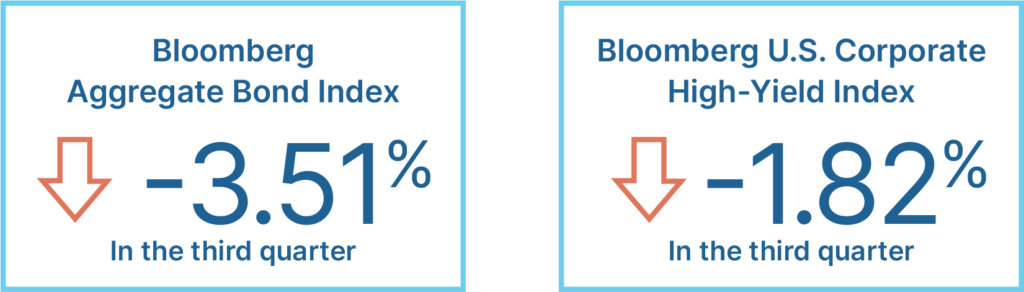
Bond markets reacted to higher yields by selling off in lockstep. The Bloomberg U.S Aggregate Index dropped more than 3.5 percent for the quarter, and other areas like high-yield and municipal bonds followed suit. Yields are currently attractive for income investors, but headwinds will persist until a resolution in the Middle East reduces inflation pressure.
Geopolitical and Economic Update: Middle East, Strong Data Lead to 20-Year Highs in Yields
With the U.S. and Iran unable to reach an agreement on ending the war and reopening the Strait of Hormuz, oil prices surged more than 30 percent, and once again began to spill into both consumer and producer inflation data.
At the same time, the employment market snapped back in August with 162,000 jobs created. The numbers of new jobs in June and July were also revised higher after weaker initial readings. This strength in hiring is indicative of a growing economy and gives the Fed more confidence to focus its policy decisions on inflation.
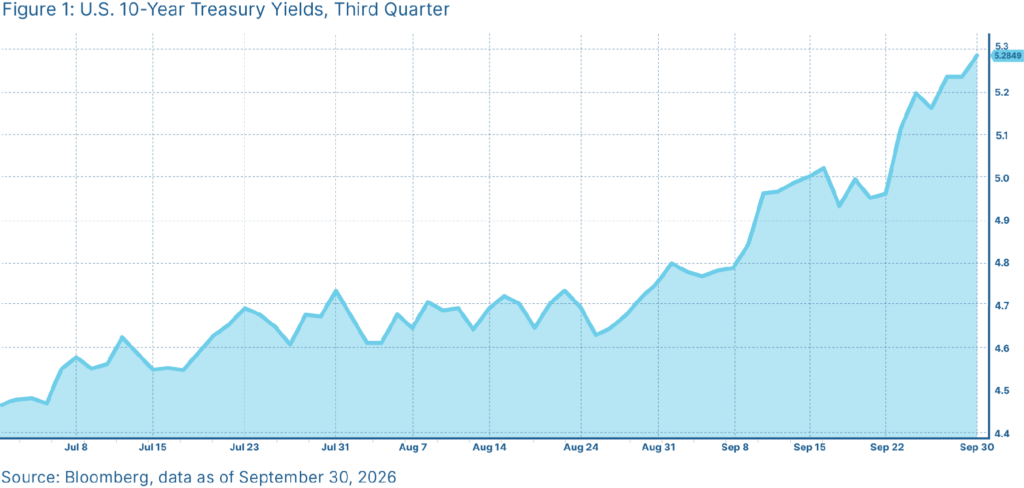
As a result, any hope the Fed would be able to reduce interest rates before year-end disappeared, and then flipped to expectations of multiple rate hikes. As sentiment on the Fed shifted, the bond market sold off. Treasury yields moved higher throughout the quarter, and the 10-year closed at the highest level since 2002.
Other factors are certainly weighing on fixed income investors, such as U.S. government debt crossing the $40 trillion level and artificial intelligence infrastructure spending leading to a stronger-than-expected economy. All combined, the bond market seems to be sending a message to the Fed that it needs to raise rates more aggressively to prevent the economy from overheating and inflation from moving higher.
The Takeaway
- A deteriorating situation in the Middle East is leading to higher oil prices and higher inflation.
- The Fed raised rates at its September meeting, and the bond market expects it to do more.
Looking Ahead: Fundamentals Remain Key
As we turn our attention to the fourth quarter, there are three important topics worth watching:
- The Middle East conflict and its impact on oil prices and inflation will continue to drive market movements and Fed policy.
- Headlines about the coming election are prevalent and likely to continue through Election Day. This could lead to short-term movements in markets.
- Earnings season will begin soon, and analysts expect third-quarter earnings will increase more than 29 percent. If this were to hold, it would mark the third straight quarter of earnings growth of more than 25 percent.
Fundamentals drive markets over the long term, and they remain relatively solid for now. Solid jobs growth, continued consumer spending, and strong earnings growth, we believe, should lead to economic growth and further market appreciation.
Risks continue to exist and need to be monitored. As a result, short-term market volatility is possible. However, a diversified portfolio that matches long-term goals and risk tolerance remains the best path forward. If concerns remain, however, speak to your financial advisor to go over your financial plans.
Disclosure: This material is intended for informational/educational purposes only and should not be construed as investment advice, a solicitation, or a recommendation to buy or sell any security or investment product. Please contact your financial professional for more information specific to your situation.
Certain sections of this commentary contain forward-looking statements based on our reasonable expectations, estimates, projections, and assumptions. Forward-looking statements are not guarantees of future performance and involve certain risks and uncertainties, which are difficult to predict. Past performance is not indicative of future results. Diversification does not assure a profit or protect against loss in declining markets. All indices are unmanaged and investors cannot invest directly into an index. The Dow Jones Industrial Average is a price-weighted average of 30 actively traded blue-chip stocks. The S&P 500 Index is a broad-based measurement of changes in stock market conditions based on the average performance of 500 widely held common stocks. The Nasdaq Composite Index measures the performance of all issues listed in the Nasdaq Stock Market, except for rights, warrants, units, and convertible debentures. The MSCI EAFE Index is a float-adjusted market capitalization index designed to measure developed market equity performance, excluding the U.S. and Canada. The MSCI Emerging Markets Index is a market capitalization-weighted index composed of companies representative of the market structure of 26 emerging market countries in Europe, Latin America, and the Pacific Basin. It excludes closed markets and those shares in otherwise free markets that are not purchasable by foreigners. The Bloomberg Aggregate Bond Index is an unmanaged market value-weighted index representing securities that are SEC-registered, taxable, and dollar-denominated. It covers the U.S. investment-grade fixed-rate bond market, with index components for a combination of the Bloomberg government and corporate securities, mortgage-backed pass-through securities, and asset-backed securities. The Bloomberg U.S. Corporate High Yield Index covers the USD-denominated, non-investment-grade, fixed-rate, taxable corporate bond market. Securities are classified as high-yield if the middle rating of Moody’s, Fitch, and S&P is Ba1/BB+/BB+ or below. One basis point (bp) is equal to 1/100th of 1 percent, or 0.01 percent.
###
Advisory services offered through Moore Wealth®, a Registered Investment Advisor.
Authored by Chris Fasciano, chief market strategist, Commonwealth Financial Network®.
© 2026 Commonwealth Financial Network®
Annual Client Appreciation Event

Join the Moore Wealth Team for Our Annual Client Appreciation Event at Hidden Hills Farm and Vineyard.
Bring the Whole Family!
We are pleased to invite you to our Annual Client Appreciation Event at Hidden Hills Farm and Vineyard! This family-friendly afternoon is our way of celebrating and thanking our valued clients for their continued trust and partnership.
Bring the whole family for an afternoon of live music, dancing, delicious food and desserts from local food trucks, optional wine tastings for adults, and plenty of fun for all ages. There will be something for everyone to enjoy!
Enjoy the Motown tunes of Quiet Fire Soul Band and dance the afternoon away!
Location:
Hidden Hills Farm and Vineyard
7550 Green Valley Road
Frederick, MD 21701
Time:
Saturday, October 17, 2026
12:00 PM – 5:00 PM
Relax, connect with the Moore Wealth Team and fellow clients, and celebrate the season with us. We look forward to spending the afternoon with you and your family!
Please RSVP by calling or emailing Olga at 301.631.1207
or olga@moorewealthinc.com
The Generational Divide

What happens when two generations compare notes?
Parents often wonder what their children need to know. Adult children often wonder what their parents’ wishes are.
The Generational Divide, hosted by Moore Wealth, is an interactive evening designed to bring both generations together for conversations that matter most.
We’ll explore:
- What is a legacy? Beyond money, what do you want your family to carry forward?
- What conversation haven’t we had? What do parents want their children to understand, and what do children wish their parents would share?
- What happens when life throws a curveball? How prepared is your family for taxes, estate documents and the unexpected?
This isn’t a lecture. It’s an opportunity to listen, compare perspectives and start a conversation that matters.
Join Us
Thursday, October 29, 2026
4:30 – 6:00 PM
The Delaplaine Arts Center
40 S. Carroll St. Fredrick, MD 21701
A light dinner of sandwiches and salads will be provided.
Bring your parents. Bring your adult children. Come as a family.
Because a strong legacy isn’t just about what you leave behind.
It’s about what you talk about with you’re here.
We look forward to seeing you there.
Advisory services offered through Moore Wealth®, a Registered Investment Adviser. Moore Wealth is located at 50 Carroll Creek Way, Suite 335, Frederick MD 21701. They can be reached at 301-631-1207.